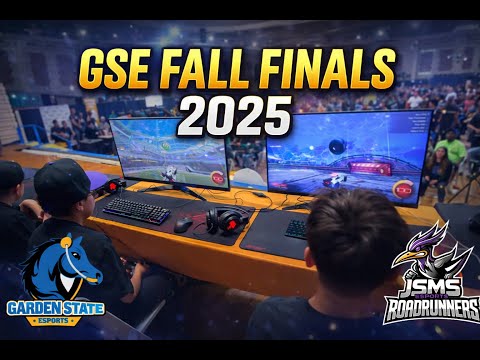
See It In Action
Jonas Salk Middle School • Old Bridge, NJ
A structured, curriculum-driven esports program where every student, regardless of skill level, has a role, a purpose, and a place.
Library table. Six Chromebooks. An idea.
Dedicated arena. School-wide tournaments. Lunch programs. Board-approved curriculum.
Approved by the Old Bridge Township Board of Education, launching as a full elective course Fall 2026.
Gaming
with a
purpose.
Gaming already has students' attention. The question is what we do with it.
Middle School Technology Innovation: Esports is a structured, standards-aligned elective that uses gaming as a vehicle for learning. Students explore digital citizenship, digital wellness, teamwork, communication, gaming history, esports, technology, leadership, and career pathways before applying what they learn through authentic projects and experiences.
This is not a free-play class. Students learn that esports is much bigger than the player on the screen. Students rotate through six roles: Player, Coach, Content Creator, Shoutcaster, Statistician, and Community Manager. Every role contributes to a successful esports team.
Not every student needs to be the best player in the room. Every student needs an opportunity to contribute.
The course culminates in students designing, building, playtesting, and showcasing their own esports experiences. It's where the skills they've developed throughout the year get put into practice.
The goal is simple: use something students already care about to help them discover what they are capable of.
Unit 1
Digital Citizenship
How do we behave online?
Unit 2
Mindful Gaming
How do we work as a team?
Unit 3
History of Gaming
Where did this come from?
Unit 4
Foundations of Esports
How does esports actually work?
Unit 5
Esports Capstone
Build it. Test it. Showcase it.
Every student is assigned a role. Every role has responsibilities before, during, and after each session. Students who have never touched a controller have found their place here.
Player
Competes with focus and intention. Applies strategy, communicates clearly, accepts coaching with an open mind.
Coach
Leads strategy, calls plays, gives feedback that lifts players up. Manages team emotions under pressure.
Content Creator
Captures highlights and key moments. Edits clips and takes photos. Represents the program with pride.
Shoutcaster
Narrates gameplay live, builds energy, interviews players, keeps the audience engaged. Positive energy only.
Statistician
Tracks scores, records outcomes, identifies patterns. Shares data to help, not to criticize.
Community Manager
Monitors tone and energy. Encourages teammates. Sets the standard for everyone in the room.
Respect
How we treat teammates, opponents, equipment, and ourselves.
Effort
How we respond when things become difficult.
Growth
How we learn from mistakes and improve.
These aren't just rules for gameplay. They are expectations for how students work, communicate, lead, and learn throughout the course.
When things get difficult: A-Team Processing
Across all three grade levels, students design, build, playtest, and showcase an original esports experience.
Students may work with tools such as UEFN, Mario Maker 2, Minecraft, or other teacher-approved platforms. The tool is not the goal. Creation, iteration, teamwork, and execution are.
Independent studies on scholastic esports programs report measurable outcomes in attendance, social development, and student wellbeing. Findings below are drawn from specific studies, not presented as universal outcomes.
33.5%
lower absence rate for esports participants vs. non-participants
Moreno Valley Unified School District, 2023
70.8%
of surveyed students said esports helped them make and keep friends
Albuquerque Public Schools survey, 2025

Sources: NASEF, Connected Learning Lab at UC Irvine, Garden State Esports
| Study | Year | Organization | Population | Finding |
|---|---|---|---|---|
| Scholastic esports attendance study | 2023 | Moreno Valley Unified School District | District esports participants vs. non-participants | 7.34 additional school days per year; 33.5% lower absence rate |
| Student wellbeing & friendship survey | 2025 | Albuquerque Public Schools | 212 surveyed students | 70.8% reported esports helped them make and keep friends |
| Sportsmanship outcomes survey | 2025 | Albuquerque Public Schools | 212 surveyed students | 66.5% reported improved sportsmanship |
| Student interviews on belonging | — | NASEF / Connected Learning Lab, UC Irvine | Scholastic esports program participants | Qualitative reports of community and belonging |
| Regained instructional days across GSE schools | — | Garden State Esports | Participating New Jersey schools | Average of 259.5 student days of instruction regained annually |
Figures reflect findings from the specific studies and districts cited, not universal or guaranteed outcomes. Contact for full source links.
I realized they are really good people — they're family.— Student interview, NASEF / Connected Learning Lab, UC Irvine
This photo was taken during a match.
One student watched the action, pointed toward the screen, and talked his teammate through what he was seeing in real time. That's coaching. That's communication. That's teamwork. Everyone has a role. Everyone has a way to contribute.
Interested in bringing esports into education? Whether you're an educator exploring the curriculum, a school or community partner interested in collaboration, or simply curious about our approach, we'd love to connect.
Reach out and learn more about JSMS Esports.